
Master your metabolism with our comprehensive guide to the Total Daily Energy Expenditure Calculator. Learn how to calculate BMR, optimize activity levels, and achieve your weight goals through science-backed data.
Master your metabolism with our comprehensive guide to the Total Daily Energy Expenditure Calculator. Learn how to calculate BMR, optimize activity levels, and achieve your weight goals through science-backed data. Total Daily Energy Expenditure Calculator:…
Master your metabolism with our comprehensive guide to the Total Daily Energy Expenditure Calculator. Learn how to calculate BMR, optimize activity levels, and achieve your weight goals through science-backed data.
Understanding how your body burns energy is the first step toward achieving any fitness goal. Whether you want to lose weight, build muscle, or simply maintain your current physique, you need a roadmap. That roadmap is built on data. At the core of this data is the Total Daily Energy Expenditure Calculator.
Many people guess how much food they need. They might eat less to lose weight or eat more to gain size, but without precise numbers, this is just a shot in the dark. By understanding your daily energy output, you can create a nutrition plan that works specifically for your biology. This guide will walk you through every aspect of energy expenditure, from the science of your metabolism to practical applications for your diet.
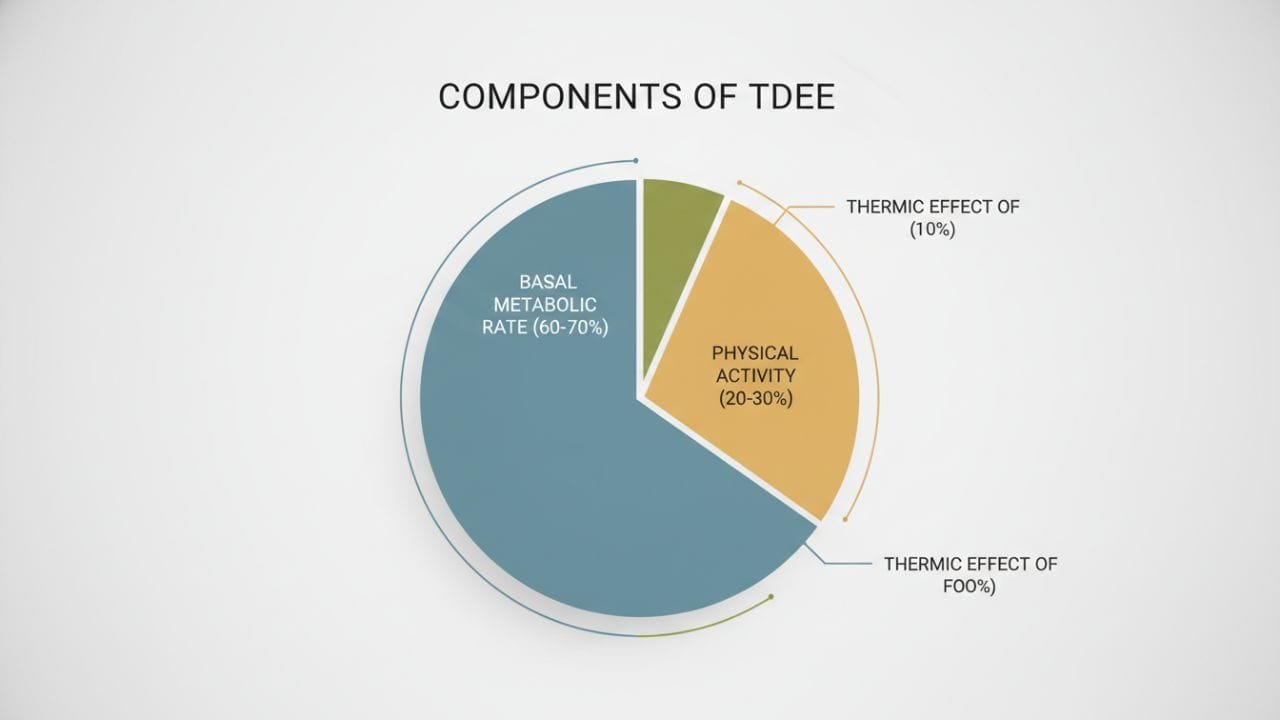
Total Daily Energy Expenditure, often abbreviated as TDEE, represents the total number of calories your body burns in a single 24-hour period. It is not just the calories you burn while running on a treadmill or lifting weights. In fact, exercise is often a smaller part of the equation than people realize.
Your body is a complex machine that requires fuel constantly, even when you are sleeping. TDEE is the sum of all these energy-burning processes. When you calculate this number, you unlock the secret to weight management. If you eat exactly your TDEE, your weight stays the same. If you eat more, you gain weight. If you eat less, you lose weight.
To fully grasp how a TDEE calculator works, you must understand the three main pillars of Energy Expenditure:
The foundation of your daily calorie burn is your Basal Metabolic Rate. This accounts for approximately 60% to 70% of the total calories you burn each day. Imagine you stayed in bed all day without moving a single muscle; the calories your body would burn just to keep your heart beating, your lungs breathing, and your brain functioning is your BMR.
Because BMR is such a massive part of the equation, small changes in your metabolic health can have significant impacts over time. Factors such as age, gender, height, and genetics play a major role here. However, the most controllable factor is muscle mass. Muscle tissue requires more energy to maintain than fat tissue, which means individuals with more muscle generally have a higher BMR.
You may hear the terms BMR and Resting Energy Expenditure (REE) used interchangeably. While they are very similar, they are not identical. BMR is measured under very strict laboratory conditions—usually immediately after waking up, in a dark room, after fasting. REE is measured under less strict conditions and is often about 10% higher than BMR because it includes small amounts of energy used for digestion or recent movement.
For the purpose of a standard BMR Calculator, the difference is negligible for most people. The goal is to get a baseline number that serves as the starting point for your nutrition plan. If you are looking for a reliable tool to find this baseline, you can check the BMR Calculator to get started with the math.
How do we determine this number without a laboratory? Scientists have developed several formulas over the last century to estimate BMR based on body metrics. A good TDEE calculator will use one of these proven equations.
This is currently considered the most accurate formula for the general population. It was introduced in 1990 and updates older formulas to reflect modern lifestyles. It takes into account your weight, height, age, and gender to provide a very close estimate of your metabolic baseline.
If you have access to your Body Fat Percentage, the Katch-McArdle formula is superior. Unlike other equations that guess your body composition based on weight and height, this formula uses your lean body mass. This makes it highly effective for athletes or very lean individuals who might be classified as “overweight” by standard BMI charts due to muscle mass.
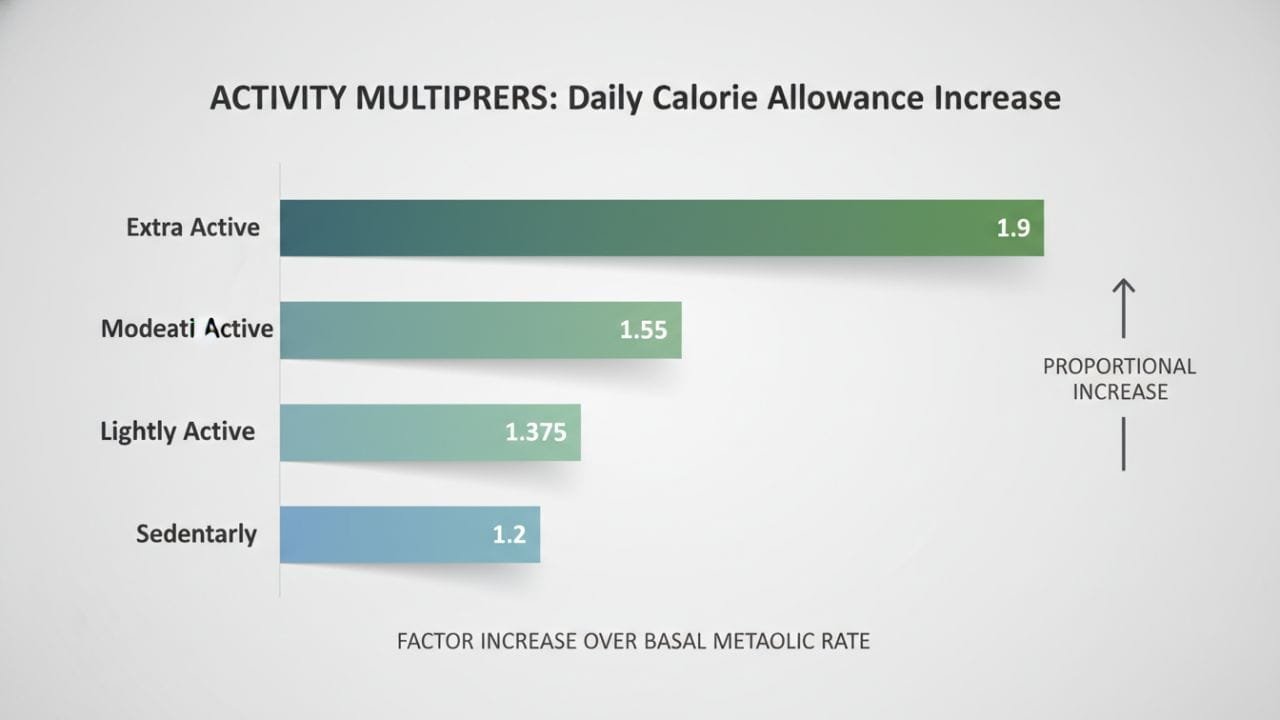
Once you have your BMR, you must account for movement. This is done using a Physical Activity Level (PAL) index, often referred to as an Activity Multiplier. This is where most people make mistakes in their calculations. It is easy to overestimate how active we really are.
The calculator takes your BMR and multiplies it by a specific number based on your lifestyle. Be honest with yourself when selecting your activity level. Overestimating this will lead to a higher calorie count, which might hinder weight loss progress.
| Activity Level | Multiplier | Description |
|---|---|---|
| Sedentary | 1.2 | Little to no exercise, desk job. |
| Lightly Active | 1.375 | Light exercise/sports 1-3 days/week. |
| Moderately Active | 1.55 | Moderate exercise/sports 3-5 days/week. |
| Very Active | 1.725 | Hard exercise/sports 6-7 days/week. |
| Extra Active | 1.9 | Very hard exercise/physical job or 2x training. |
The Thermic Effect of Food is the “hidden” calorie burner. It represents the energy required to process the food you eat. Interestingly, not all foods are created equal in this regard. This is why the quality of your calories matters just as much as the quantity.
Protein has the highest thermic effect. Your body uses approximately 20% to 30% of the calories in protein just to digest it. Carbohydrates have a moderate TEF of about 5% to 10%, while fats have the lowest at 0% to 3%. This is one reason why high-protein diets are often recommended for fat loss; they naturally increase your Metabolic Rate simply through digestion.
To find your Daily Calorie Needs, the calculation brings all these factors together. The formula generally looks like this:
TDEE = (BMR x Activity Multiplier) + TEF
Most online calculators simplify this by baking the TEF estimate into the activity multiplier. The final number you receive is your maintenance level. This is the exact number of calories you can eat every day to remain at your current weight.
Understanding this “maintenance calories” number is the most powerful tool in your nutritional arsenal. It removes the guesswork. You are no longer “dieting” blindly; you are managing a mathematical equation.
Once you know your TDEE, you can manipulate it to change your body. If your goal is to shed fat, you need to create a Caloric Deficit. This means you consume fewer calories than your TDEE.
A standard Weight Loss Calculator approach suggests a deficit of 500 calories per day. Mathematically, one pound of fat contains roughly 3,500 calories. Therefore, a 500-calorie daily deficit should theoretically result in one pound of fat loss per week. This is considered a safe and sustainable rate of weight loss.
However, aggressive deficits can backfire. Cutting calories too drastically can cause your body to lower its BMR to preserve energy—a survival mechanism often called “starvation mode.” It is crucial to find a balance. To see how different deficits affect your timeline, you can use the Calorie Deficit Calculator.
When discussing TDEE and health, we often encounter Body Mass Index (BMI). While BMI is a useful screening tool for the general population to estimate weight categories (underweight, normal, overweight, obese), it has significant limitations for individuals interested in detailed energy expenditure.
BMI calculates your status based solely on height and weight. It does not distinguish between muscle and fat. A bodybuilder with low body fat might be classified as “obese” by BMI standards because muscle is dense and heavy. For accurate TDEE calculations, relying on body fat percentage and lean mass is far more accurate than relying on BMI.
Knowing your calorie limit is step one. Step two is determining your Macronutrient Ratio. This refers to the balance of proteins, fats, and carbohydrates in your diet. While calories dictate weight loss or gain, macronutrients dictate body composition (how much muscle vs. fat you have).
There is no single “perfect” ratio, as it depends on your goals. An endurance runner needs more carbohydrates for fuel, while a weightlifter needs more protein for repair. Adjusting these ratios can also help you manage hunger and energy levels throughout the day.
| Goal | Carbohydrates | Protein | Fats |
|---|---|---|---|
| Balanced Health | 45-65% | 10-35% | 20-35% |
| Low Carb / Keto | 5-10% | 20-30% | 60-75% |
| Muscle Gain | 40-50% | 30-40% | 20-30% |
| Fat Loss | 30-40% | 40-50% | 20-30% |
If you are unsure which split is right for you, experimenting with a Macro Calculator can help you visualize how these ratios translate into grams of food on your plate.

Calorie Maintenance is often overlooked, but it is a critical phase. After a long period of dieting, your body needs a break. Eating at your maintenance TDEE allows your hormones to recover and your metabolism to stabilize. Many fitness experts recommend “diet breaks”—periods of one to two weeks where you eat at maintenance—to prevent metabolic adaptation.
Furthermore, if your goal is performance rather than aesthetics, eating at maintenance provides the most energy for workouts without the risk of gaining unwanted fat. It is the “sweet spot” for athletic performance.
Is it possible to increase your TDEE without spending hours in the gym? Yes. While you cannot change your age or genetics, you can influence other factors of your Metabolic Rate.
NEAT stands for Non-Exercise Activity Thermogenesis. This includes all the movement you do that isn’t sleeping, eating, or sports-like exercise. Walking to the car, typing, fidgeting, and cleaning the house are all NEAT. Increasing your daily steps is the easiest way to significantly boost your TDEE.
As mentioned earlier, muscle is metabolically expensive tissue. By engaging in resistance training and building lean mass, you permanently increase your BMR. This means you burn more calories every second of the day, even while watching TV.
Leveraging the Thermic Effect of Food by increasing protein intake is a simple dietary switch that boosts energy expenditure.
Even with the best calculator, human error can lead to inaccurate results. Be aware of these common pitfalls:
A TDEE calculator provides an estimate, not a prophecy. It is a starting point. The real data comes from monitoring your body’s response.
Start by eating at the calculated number for two weeks. Monitor your weight daily and take an average at the end of the week. If your weight stays the same, the calculator was accurate. If you lost weight, your TDEE is actually higher than calculated. If you gained weight, your TDEE is lower.
Adjust your intake by 100 to 200 calories based on these real-world results. This feedback loop is the secret to long-term success.
Mastering your nutrition starts with mastering the math. The Total Daily Energy Expenditure calculator is more than just a tool; it is the compass that guides your fitness journey. By understanding the interplay between your Basal Metabolic Rate, your Physical Activity Level, and the food you eat, you gain control over your body.
Remember that consistency is key. Calculate your numbers, trust the process, and make adjustments based on data rather than emotion. Whether you are looking to shed a few pounds, build a muscular physique, or simply live a healthier life, the science of energy expenditure is your greatest ally. Start today, track your results, and watch your goals become reality.
To ensure a deep understanding of the concepts discussed, below are definitions of technical terms used in this article, linked to authoritative sources.